
If you've spent any time researching smile makeovers, you've probably run into two names again and again: composite bonding and porcelain veneers. Both can turn chipped, gapped, or discoloured teeth into a smile you actually want to show off in photos. But they work in very different ways, cost different amounts, and suit different people.
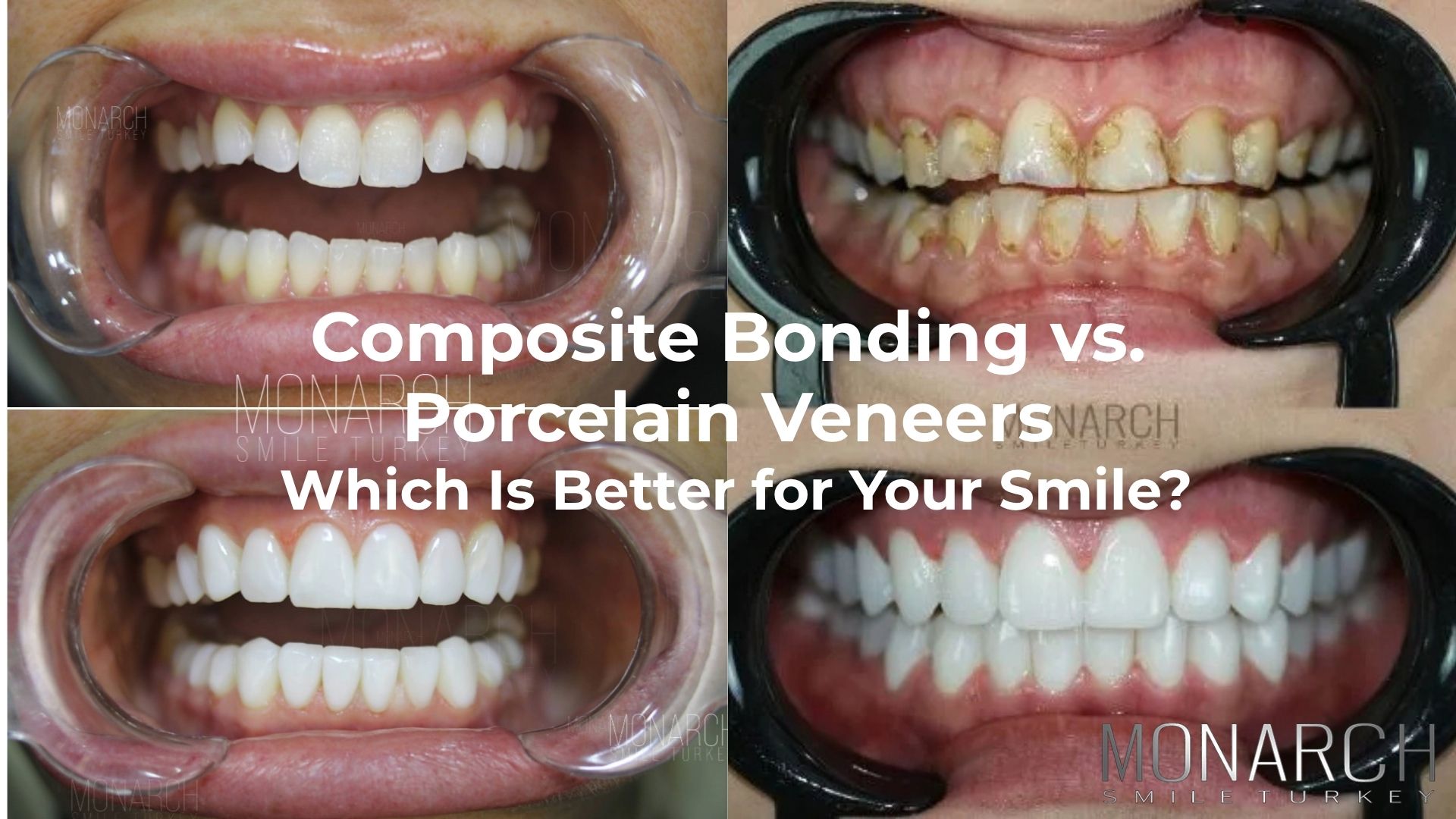
At Monarch Smile Turkey, this is one of the questions we hear most often during consultations - usually from patients who've already watched a dozen before-and-after videos online and still aren't sure which treatment fits their situation. So let's break it down properly: what each treatment actually involves, how they compare, what a visit looks like, and how to figure out which one makes sense for your smile, your budget, and your timeline.
Understanding Composite Bonding: Quick, Non-Invasive Smile Enhancements
Composite bonding is exactly what it sounds like - a tooth-coloured resin is applied directly to your existing teeth, shaped by hand, and hardened with a curing light. There's no lab involved, no impressions sent off for fabrication, and in many cases, little or no natural enamel needs to be removed.
It's a great fix for the smaller stuff: a chipped front tooth, a gap between your incisors, slightly uneven edges, or teeth that have picked up some staining over the years. Because the dentist is sculpting the material by hand, chair-side, you can often walk in with a flaw and walk out a couple of hours later without it - sometimes in a single appointment.
The trade-off is that composite resin isn't as hard-wearing as porcelain. It can pick up stains from coffee, tea, or red wine over time, and it's more prone to chipping if you bite into something hard. Composite bonding can often last around five to ten years, although its lifespan varies considerably depending on bite forces, oral habits, diet, maintenance, and the location of the bonded tooth.
Understanding Porcelain Veneers: How They Work and How Long They Last
Porcelain veneers take a different approach entirely. Instead of building material onto your tooth, a thin custom shell - made from porcelain or other dental ceramics, such as lithium disilicate - is fabricated to fit over the front surface of your tooth and bonded securely to the tooth surface.
Because each veneer is custom-made to match your bite, gum line, and desired shade, the process takes a bit more planning. In many cases, the dentist removes a small amount of enamel to create space for the veneer, although the amount of preparation varies according to the tooth position, veneer design, and clinical situation. Detailed impressions or digital scans are then taken, and the design is sent to a lab (or, in clinics with in-house milling like ours, produced on-site). That's one reason porcelain veneers are commonly considered when several visible teeth need a consistent change in shape, shade, or proportion.
The upside is longevity and resilience. Porcelain resists staining far better than composite, holds its shape and shine for a decade or more, and gives that slightly translucent, light-reflecting quality that reads as natural rather than "done." Porcelain veneers can often last 10-15 years or longer with appropriate care, although individual results vary. It's a bigger commitment upfront, but for patients seeking a more extensive change in tooth shape, shade, and overall smile consistency, porcelain veneers may be a suitable option.
Key Differences: Material, Appearance, and Longevity
Here's how the two compare side by side, once you strip away the marketing language:
| Composite Bonding | Porcelain Veneers | |
|---|---|---|
| Material | Tooth-coloured resin, applied directly | Custom-made porcelain/ceramic shell |
| Typical lifespan | 5-10 years | 10-15+ years |
| Enamel removal | Little to none | Thin layer may be removed depending on the case |
| Reversibility | Often minimally invasive; may be reversible in some cases | Generally not reversible when enamel has been removed |
| Stain resistance | Moderate - can discolour over time | High - more stain-resistant than composite resin |
| Chair time | Often one visit | Multiple visits, including design and fitting |
| Best for | Minor chips, gaps, small touch-ups | Full smile makeovers, uniform Hollywood Smile results |
The honest way to think about it: composite bonding is a skilled sculptor working with what's already there, while porcelain veneers are precision-engineered pieces designed to replace the visible surface of the tooth entirely. Neither is "better" in the abstract - they're built for different jobs.
The Treatment Process: What to Expect During Your Visit
For composite bonding, the appointment itself is refreshingly simple. Your dentist prepares the tooth surface, usually using an etching and bonding system to help the composite adhere properly, then applies the resin in thin layers, shapes it to match your natural tooth contour, and cures each layer with a light. A bit of polishing at the end blends it in with your surrounding teeth, and that's it - no numbing is usually required unless a chip is being repaired near sensitive tissue.
Porcelain veneers involve more steps and require more detailed planning. It typically starts with a consultation and digital smile design, where you and your dentist map out the shape, size, and shade you're after - this is also where photos and sometimes a mock-up are used so you can see roughly what to expect before any permanent work begins. Next comes the preparation appointment, where a small amount of enamel may be removed and impressions or scans are taken. Temporary veneers may be fitted while the final restorations are being produced, particularly when tooth preparation has been required. Once they're ready, your dentist checks the fit, colour, and bite before bonding them in place. For international patients, this whole process is often condensed into a single trip, with the design and fitting stages scheduled a few days apart so you can enjoy your time in Turkey while your smile comes together.
Cost and Value: Short-Term Savings vs. Long-Term Investment
Composite bonding is generally less expensive upfront. Because it doesn't require lab work and can often be completed in one sitting, it's the more affordable option per tooth - which makes it appealing if you're addressing one or two spots rather than your whole smile, or if you want to test out a look before committing to something permanent.
Porcelain veneers cost more initially. For some patients, the longer lifespan and greater stain resistance of porcelain veneers may provide better long-term value, although this depends on the initial cost, maintenance needs, oral habits, and how long the restorations last.
This is also where dental tourism changes the equation. Treatment costs in Turkey can be lower than in the UK, US, and parts of Western Europe. However, price should not be the only factor when choosing a clinic. Patients should also consider the dentist's qualifications and experience, the condition of their natural teeth, the ceramic system being used, treatment planning, laboratory standards, and the aftercare provided. It's worth getting a personalised quote, since the right number depends on how many teeth you're treating and the material you choose.
Composite Bonding vs. Porcelain Veneers Cost in Turkey
Treatment costs in Turkey vary depending on the clinic, dentist, number of teeth being treated, case complexity, and the materials used. As a general guide, composite bonding is usually the more affordable option per tooth, while porcelain veneers have a higher initial cost because they involve custom-made ceramic restorations and additional treatment stages.
| Treatment | Typical Cost in Turkey (Per Tooth) |
|---|---|
| Composite Bonding | £80-£180 |
| Porcelain Veneers | £180-£350 |
| E-max Veneers | £200-£400 |
These figures are approximate market ranges rather than fixed treatment prices. The total cost of a smile makeover depends primarily on how many teeth need treatment and whether additional procedures are required. A clinical assessment is therefore necessary before an exact treatment plan and price can be provided.
Which Option Is Right for You? Factors to Consider
A few honest questions can point you toward the right answer:
How much are you actually correcting? If it's one chipped tooth or a small gap, bonding will likely do the job beautifully without over-treating healthy teeth. If you're after a complete, uniform transformation across your smile, veneers are built for that kind of consistency.
How long do you want it to last? If you're comfortable with maintenance and touch-ups every several years, bonding is generally the more conservative option. If you're looking for a longer-lasting restoration with greater stain resistance, porcelain veneers may be more suitable.
Do you want the option to change your mind? Composite bonding is usually minimally invasive because little or no enamel needs to be removed. In some cases, the bonding material can be removed or replaced with minimal alteration to the underlying tooth. However, whether treatment is fully reversible depends on how the tooth was prepared and the individual clinical situation. Veneers often involve permanent enamel removal, so it's worth being confident in your decision before you start.
What's your budget and timeline? If cost is the deciding factor and you're not travelling for treatment, bonding is easier to fit into a smaller budget. If you're already planning a trip to Turkey, the price gap between the two treatments may narrow, and veneers can become a realistic option for more patients.
Before either treatment, your dentist should check the health of your teeth and gums and assess your bite. Active tooth decay, untreated gum disease, significant enamel loss, severe tooth misalignment, or teeth grinding may need to be addressed before cosmetic treatment. In some cases, orthodontics, whitening, crowns, or another treatment may be more appropriate than bonding or veneers.
Neither option is right for every patient. The most appropriate treatment depends on the condition of your teeth, enamel, bite, gums, aesthetic goals, and how much tooth modification would be required. A consultation (in person or via photos, if you're planning treatment from abroad) is really the only way to get an honest recommendation specific to your teeth.
Composite Bonding Before and After in Antalya, Turkey
Our Final Recommendation
If you only want to correct one or two minor imperfections - such as a small chip, gap, or uneven edge - composite bonding is generally the more conservative and cost-effective place to start. It usually requires little or no enamel removal, can often be completed in a single visit, and leaves more flexibility for future treatment.
If your goal is a more comprehensive smile makeover involving several visible teeth, and you prioritise long-term colour stability, durability, and consistency in tooth shape and shade, porcelain veneers are generally the stronger option. They require a greater financial and clinical commitment, and enamel preparation may be necessary, but they are typically better suited to patients seeking a substantial, long-lasting aesthetic transformation.
In short: choose composite bonding for smaller, conservative corrections; consider porcelain veneers for a broader and longer-term smile transformation. The final decision should still be based on a clinical examination of your teeth, gums, enamel, and bite rather than appearance or price alone.
Composite Bonding Patient Reviews at Monarch Smile Turkey in Antalya, Turkey
Frequently Asked Questions (FAQ)
Which treatment offers longer-lasting results, composite bonding or porcelain veneers?
Porcelain veneers generally last longer overall - often around ten to fifteen years or more with good care, compared with approximately five to ten years for composite bonding. However, the lifespan of either treatment varies depending on bite forces, oral habits, maintenance, and the individual clinical situation. Veneers also tend to hold their colour and shine better over time because porcelain is more stain-resistant than composite resin.
Is the procedure for composite bonding reversible?
Composite bonding is usually minimally invasive because little or no enamel needs to be removed. In some cases, the bonding material can be removed or replaced with minimal alteration to the underlying tooth. However, whether treatment is fully reversible depends on how the tooth was prepared and the individual clinical situation.
Does composite bonding stain over time?
Composite resin can gradually pick up surface staining, particularly from coffee, tea, red wine, tobacco, and other strongly pigmented substances. Professional polishing can sometimes improve surface discolouration, although composite is generally less stain-resistant than porcelain.
How long does it take to complete composite bonding versus porcelain veneers?
Composite bonding can often be finished in a single appointment, sometimes in as little as an hour or two depending on how many teeth are involved. Porcelain veneers take longer because each shell is custom-made - expect a design consultation, a preparation appointment, and a final fitting, usually spread across a few days for patients treating multiple teeth.
Is teeth shaving required for both composite bonding and porcelain veneers?
Not usually for bonding - the resin is added onto the tooth surface with minimal to no enamel removal. Veneers, on the other hand, often require a small amount of enamel to be removed so the ceramic shell can sit naturally within the smile. The amount of preparation varies depending on the tooth position, veneer design, and individual clinical situation.
Which option is more cost-effective for a full smile makeover?
For a handful of teeth, bonding is usually cheaper upfront. For a full smile makeover, porcelain veneers may offer better long-term value for some patients because they generally have a longer lifespan and greater stain resistance than composite bonding. The most cost-effective option depends on the number of teeth being treated, the initial treatment cost, maintenance requirements, oral habits, and how long the restorations last.
Still deciding between composite bonding and porcelain veneers? The team at Monarch Smile Turkey can review your photos, talk through your goals, and put together a treatment plan that fits your smile and your budget - reach out for a free consultation and receive a personalised assessment before you book anything.